
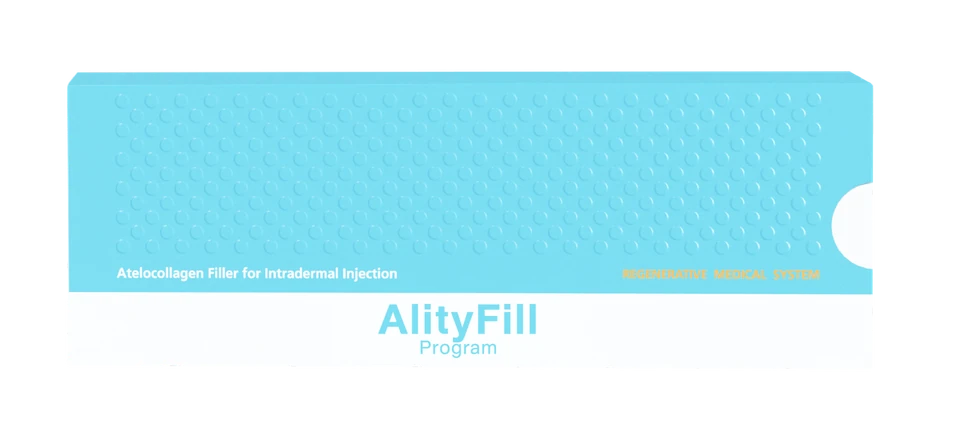
What is TheraFill?
TheraFill is a Collagen Filler, with collagen as its main ingredient.
Injected collagen directly fills folds or thinning tissue, unlike some collagen stimulators that rely on the body gradually producing collagen itself.
According to the manufacturer, the main purpose is temporary improvement of facial wrinkles and folds by injecting collagen into tissue.
Unlike common Hyaluronic Acid fillers, TheraFill uses porcine Type I collagen, with Telopeptides removed to reduce molecular components associated with immune stimulation.
It contains Porcine Type I Atelocollagen 3% + Lidocaine 0.3%, in a 1 ml syringe.
What is Atelocollagen?
Natural collagen has Telopeptides at the molecular ends, associated with immune stimulation.
TheraFill has these Telopeptides removed, hence Atelocollagen.
The manufacturer states that this reduces collagen's immune response compared with collagen retaining these components.
What is TheraFill collagen derived from?
TheraFill uses Porcine Collagen Type I or type 1 collagen derived from pigs
This differs from some older Collagen Fillers made from cattle, or Bovine Collagen.
TheraFill studies explicitly state the studied product contains Porcine Collagen Type I 3% and Lidocaine 0.3%.
What does TheraFill help with?
It suits relatively natural-looking filling, such as:
- Facial folds
- Nasolabial folds
- Wrinkles visible without expression
- Thinning tissue
- Areas needing filling without a strongly volumizing HA filler
- Smoothing and tissue quality rather than facial sculpting
TheraFill's clearest clinical evidence concerns Nasolabial Folds, with follow-up through 12 months.
Is TheraFill suitable for under-eyes?
As a collagen filler, TheraFill is used clinically in relatively thin skin requiring fine filling.
The main under-eye problem must first be identified.
If there is:
- Thin skin
- Small lines
- Thinning tissue
- Shallow folds
The doctor may consider collagen products according to the skin characteristics.
For deep troughs caused by bone structure or substantial under-eye volume loss, HA Filler or other methods may also be needed.
Selection should depend on the cause of the trough, rather than the word “under-eye” alone.
Is TheraFill suitable for facial sculpting?
TheraFill does not focus on Projection or Contouring like firm fillers.
For needs such as:
- Chin length
- Chin sculpting
- Raising the nasal bridge
- Creating a jawline
- Increasing anterior-cheek Projection
HA Fillers designed for structural work are more suitable.
TheraFill focuses on filling tissue and folds, rather than sculpting shape.
Are TheraFill results immediate?
Filling is visible early after injection because collagen is placed directly in tissue.
Early injection-related swelling may also occur, so wait for it to decrease before reassessing.
How long does TheraFill last?
For the webpage, the recommended explanation is:
A direct TheraFill study followed participants for 12 months, still finding improved nasolabial folds compared with baseline at month 12.
However, effect levels gradually decrease, with satisfaction/change scores declining markedly after approximately 6 months.
Therefore, do not claim TheraFill definitely lasts 12–24 months; available product-specific clinical evidence more clearly supports up to approximately 12 months.
Actual duration also depends on:
- Site
- Fold depth
- Amount used
- Movement in the area
- Age and skin condition
- Individual collagen breakdown
Why do results gradually decrease?
Collagen is a protein the body naturally breaks down.
TheraFill research explains that injected collagen is gradually digested by the body's Collagenase enzymes, reducing filling effects over time.
It is therefore not a permanent filler.
How many TheraFill sessions are needed?
There is no fixed count for everyone.
The nasolabial TheraFill study assessed at around 2 weeks, allowing one additional Touch-up session if the first filling was insufficient.
In actual practice, the doctor considers:
- Concern to correct
- Fold depth
- Collagen amount needed
- First-session result
Not everyone needs the same multiple-session plan.
Does TheraFill contain Lidocaine?
Yes.
TheraFill contains 0.3% Lidocaine to reduce injection pain.
Tell the doctor of any Lidocaine allergy before treatment.
How does TheraFill differ from HA Filler?
The main difference is the injected material.
TheraFill
- Porcine Type I Atelocollagen 3%
- Collagen Filler
- Focuses on tissue and fold filling
- Not Hyaluronic Acid
- Limited emphasis on Projection sculpting
HA Filler
- Hyaluronic Acid
- Various firmness levels
- From folds to structural facial sculpting
- Can be dissolved with Hyaluronidase
Neither is necessarily better; they suit different applications.
Can Hyaluronidase dissolve TheraFill?
No.
TheraFill is not Hyaluronic Acid and cannot be dissolved with Hyaluronidase like HA Filler.
Collagen gradually breaks down through the body's own processes.
Know this before treatment: unlike HA Filler, there is no corresponding direct dissolving drug for this product.
How does TheraFill differ from Sculptra?
Both relate to collagen but work differently.
TheraFill
Collagen is injected directly into tissue, providing material-based filling immediately after injection.
Sculptra
A PLLA Biostimulator, not direct collagen injection; it gradually stimulates the body's own collagen production.
Sculptra results therefore develop gradually after treatment, while TheraFill provides product-based filling from the start.
How does TheraFill differ from Skinbooster?
Most Skinboosters focus on:
- Hydration
- Water-filled, dewy skin
- Skin Quality
- Small lines
TheraFill is a Collagen Filler, with a greater role in tissue and fold filling.
It is not the same kind of Skinbooster as Restylane Vital Light or Definisse Hydro.
Is a Skin Test needed before injection?
Older Collagen Fillers, particularly Bovine Collagen, used Skin Tests to check allergy before injection.
TheraFill removes Telopeptides; its research states Skin Tests like those for older bovine collagen products are unnecessary.
Still inform the doctor of allergies and underlying conditions before treatment.
Who should not receive TheraFill?
The manufacturer lists important contraindications such as:
- Allergy to porcine proteins
- Lidocaine allergy
- History of Anaphylaxis
- Autoimmune conditions or history as specified by the product
- Pregnancy or breastfeeding
- Below the product's age threshold
The doctor should take a medical history every time before treatment.
Does TheraFill contain porcine ingredients?
Yes.
TheraFill is made from Porcine Type I Collagen.
This should be clearly disclosed before treatment, especially to those who:
- Are allergic to porcine proteins
- Avoid pig-derived products
- Have dietary or belief-related restrictions concerning product origin
Does TheraFill cause swelling after injection?
After treatment, there may be:
- Swelling
- Redness
- Needle marks
- Bruising
- Pain or tightness at injection sites
TheraFill research reported injection-site swelling in some participants, with no serious product-related adverse events in that study.
How long does it take to settle after injection?
Early injection-related swelling may remain.
Generally wait 1–2 weeks before reassessing filling, consistent with the TheraFill study's approximately 2-week assessment before considering Touch-up.
How can you identify genuine TheraFill?
Before injection, you should be able to inspect the actual product being used.
Check:
- named TheraFill®
- Product box
- 1 ml syringe
- Lot number
- Expiry date
- CELLONTECH manufacturer information
- Thai-market label
- Matching information on the box and syringe
- Intact packaging
TheraFill information
- Type: Injectable Collagen Filler
- Main ingredient: Porcine Type I Atelocollagen
- Collagen concentration: 3% or approximately 30 mg/ml
- Lidocaine: 0.3%
- Volume: 1 ml / syringe
- Manufacturer: CELLONTECH
- Country: South Korea
- Shelf life: 36 months from manufacture
- Main use: Facial wrinkles and folds