


What is forehead filler?
Forehead filler involves injecting filler into the forehead to add volume or adjust shape in desired locations.
The filler commonly used is Hyaluronic Acid (HA), which fills tissue and adjusts forehead curvature to suit facial structure.
Results depend on several factors, such as:
- Original forehead shape
- Bone structure
- Tissue thickness
- Hollowing or unevenness at each location
- Filler amount and properties
- Injection technique and depth
Highlights of the forehead filler programme
- Helps fill a flat or sunken forehead
- Helps improve continuity of the forehead curve
- Helps balance the forehead, temples, and midface
- Can refine uneven areas in some cases
- Helps add facial dimension in profile
- Amount and shape can be designed for each individual
What can forehead filler improve?
Filling a flat forehead
Adds forehead volume for people with a flat forehead or little curvature.
Filling sunken forehead areas
Helps smooth sunken areas or surface discontinuities.
Adjusting the forehead curve
Curvature can be designed to suit facial structure and profile proportions.
Adjusting the forehead-to-temple transition
Some have both a flat forehead and hollow temples. Assessing both together may improve upper facial continuity.
Adjusting partial asymmetry
If forehead volume or shape differs between sides, some cases can be assessed for detail refinement.
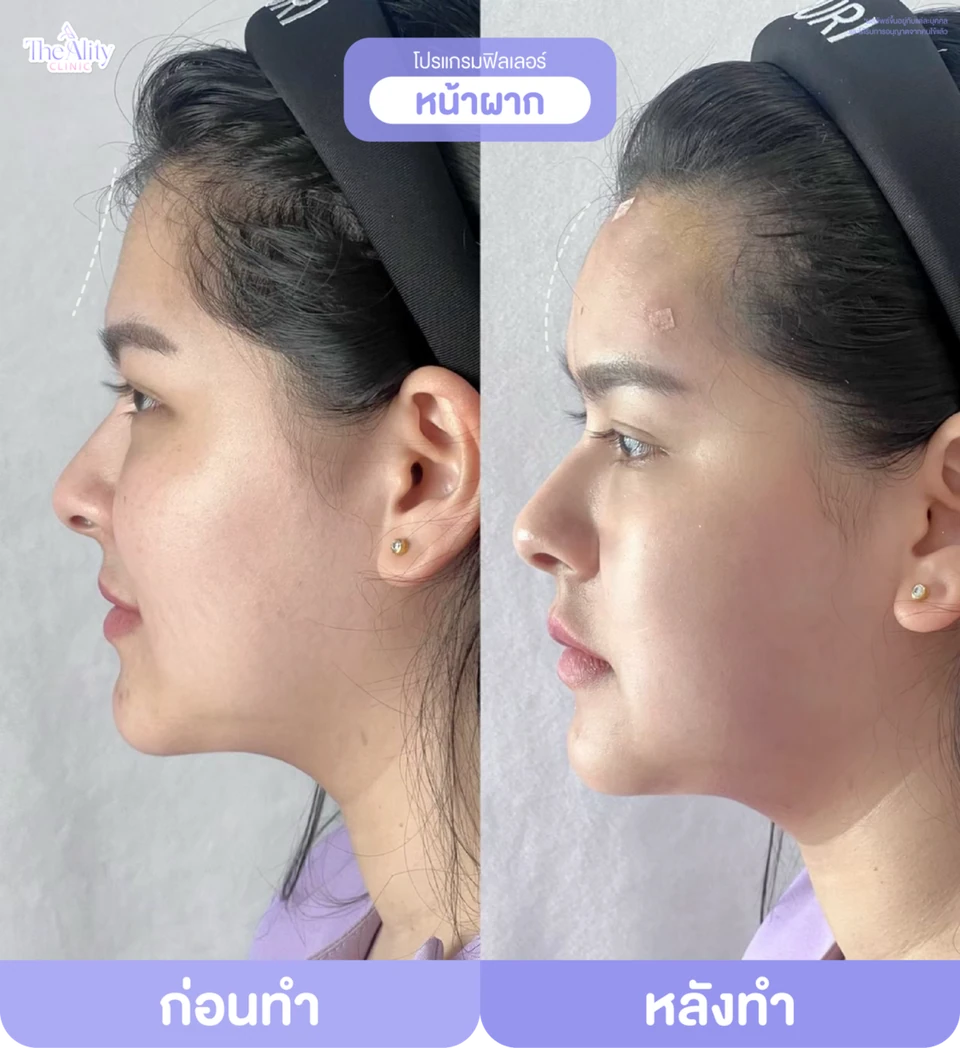
Who is forehead filler suitable for?
The forehead filler programme may be suitable for people who:
- Have a relatively flat forehead
- Have sunken or depressed forehead areas
- Want more forehead curvature
- Feel the forehead does not blend with temples
- Want to adjust upper facial proportions
- Have partial forehead asymmetry
- Want non-surgical reshaping in suitable cases
What causes a flat or sunken forehead?
Forehead shape differs individually and may be affected by factors such as:
- Natural bone structure
- Forehead tissue and fat volume
- Age-related structural changes
- Volume loss at certain locations
- Left–right structural differences
- Temple and surrounding-area shape
Assess the forehead and nearby areas before selecting filling locations.
Can forehead filler give the face a softer appearance?
More forehead curvature or volume may change upper facial appearance and give a softer impression with some facial structures.
Appearance depends on individual proportions. Design should consider temples, eyebrows, nose, and overall face alongside forehead shape.
Can forehead filler reduce wrinkles?
Filler mainly restores volume and adjusts shape; it does not reduce muscle activity.
If wrinkles arise from forehead muscle movement, such as eyebrow raising or facial expressions, other approaches may also need assessment.
For skin grooves caused by volume loss, filler may improve the surface in some cases, depending on the cause and doctor’s assessment.
How many cc of forehead filler are needed?
Amount depends on original forehead shape, flatness or hollowing, and desired result.
Some only need specific details refined; others need curvature adjusted over a broad area, so amounts differ.
The doctor assesses amounts by individual structure; do not decide by cc alone.
Which forehead filler should be selected?
Each formulation differs in:
- Gel firmness
- Elasticity
- Spread
- Shape retention
- Water retention
The forehead is broad with a relatively smooth surface, so filler spread and smoothness must also be considered.
The doctor selects properties suited to injection depth and desired result individually.
Steps in forehead filler treatment
1. Assessing forehead shape
The doctor checks curvature, hollowing, symmetry, and the relationship to temples and facial structure.
2. Planning shape and locations
Determines areas needing volume and whether temples also need adjustment.
3. Preparing the area before injection
The area is cleaned and prepared to reduce discomfort according to the clinic’s procedures.
4. Injecting filler according to the plan
The doctor gradually places filler at appropriate locations and depths.
5. Checking balance
Forehead smoothness, curvature, and symmetry are assessed after treatment.
How long does forehead filler last?
The duration of results varies between individuals and depends on several factors, such as:
- Filler formulation
- Amount used
- Injection location and depth
- Individual structure
- Metabolism
- Aftercare
Hyaluronic Acid filler gradually decreases through the body’s processes over time.
Will there be swelling after forehead filler injections?
Some people may have swelling, tightness, needle marks, or bruising after treatment.
Initially, swelling may make the forehead feel fuller than expected. Wait for symptoms to subside before assessing final shape.
If unusual symptoms occur, such as unusually severe pain, skin colour changes, visual disturbances, or concerning symptoms, contact the clinic or seek medical attention immediately.
Preparing for forehead filler injections
Before treatment, tell the doctor about:
- Underlying medical conditions
- Any history of drug allergies
- Current medicines and supplements
- Previous forehead, temple, or facial filler
- Previous filler dissolution
- Procedures or surgery nearby
- Inflammation or infection in the treatment area
Aftercare following forehead filler injections
Follow the doctor’s and clinic’s advice after treatment. In general:
- Avoid pressing, massaging, or rubbing the forehead yourself
- Avoid pressure on injection areas initially
- Avoid intense heat
- Avoid activities that may impact the face
- Keep the injection area clean
- Take medicines only as directed by the doctor
- Watch for abnormal symptoms after treatment
Is downtime needed after forehead filler?
Generally, daily activities can resume, but some may have swelling, needle marks, or bruising.
If you have an important event or activity, allow time for post-treatment symptoms to subside beforehand.
Does forehead filler make the face look larger?
Forehead filler adds volume at desired locations, so it may change forehead shape.
The aim is adjusting curvature and proportions to suit the face, rather than the maximum possible protrusion or fullness.
Amount and placement should follow individual facial structure.
How does forehead filler differ from temple filler?
Forehead filler
Adds volume or adjusts curvature in the front of the upper face.
Temple filler
Fills concave or sunken areas at the sides of the face.
Some have both a flat forehead and hollow temples. Filling one alone may leave a discontinuous curve, so the doctor may assess both together.
Do both sides of the forehead need the same amount?
Not necessarily.
Faces may have natural asymmetry or differing degrees of hollowing.
The doctor may use different amounts at different locations for better overall shape balance.
Can forehead filler be dissolved?
For Hyaluronic Acid filler, the enzyme Hyaluronidase can help dissolve it when the doctor determines there is an indication.
A doctor should assess dissolution first, considering existing filler location, amount, and characteristics.
Can I add more after previous forehead filler?
Additional filling can be assessed, but first check remaining filler amount, location, and current shape.
If brand, formulation, amount, and injection date information is available, tell the doctor before treatment.
Is forehead filler dangerous?
The forehead contains important vessels and structures, requiring anatomical knowledge and appropriate injection technique.
As with filler elsewhere, side effects or complications can occur, from swelling, bruising, or pain to uncommon but important complications such as vessel occlusion.
If unusually severe pain, skin colour changes, or visual disturbances occur after treatment, contact the clinic or seek medical attention immediately.
Frequently asked questions
Designing the forehead in balance with facial structure
The forehead affects upper facial proportions, particularly continuity between forehead, temples, eyebrows, and nose.
Forehead filler should design curvature and volume around original facial structure rather than simply increasing protrusion or fullness.
The doctor assesses shape from front and side to choose suitable locations, amounts, and filler individually.