
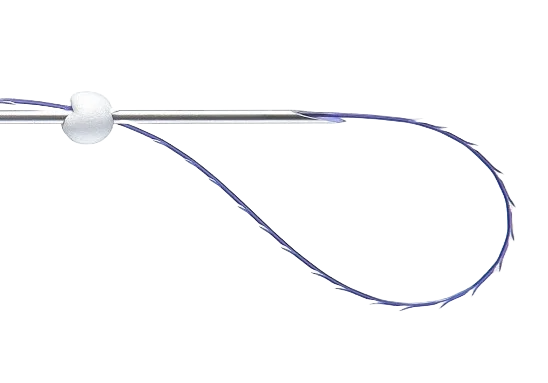
What is MINT PDO?
MINT stands for Minimally Invasive Nonsurgical Thread.
It is an absorbable PDO thread designed to anchor and support facial tissue.
After the doctor places the thread in the appropriate tissue layer, its barbs grip the tissue and support it in the planned direction. Changes in the jawline and treated areas can therefore be seen from immediately after treatment.
The thread gradually dissolves over time and does not remain permanently in the face.
MINT features PDO (Polydioxanone) threads made with Press-molded 360° Helical Barbs technology. The barbs are distributed around the thread to engage tissue in multiple directions.
Key features of MINT threads
360° barbs around the thread
MINT’s barbs are arranged around the thread in a 360° Helical Pattern.
Rather than having barbs on only 2 sides of the thread, the barbs are distributed around it, allowing tissue engagement in multiple directions.
This makes it suitable for tissue support and for planning lifting Vectors to match the facial contours.
Press-molded Barbs
Another difference is that MINT’s barbs are not made by cutting into the thread.
MINT forms its barbs on the thread using a Molding process.
The manufacturer explains that this method helps preserve the structure of the thread’s core while creating tissue-gripping barbs around it.
What is PDO?
PDO, or Polydioxanone, is an absorbable synthetic material that has long been used for medical sutures.
Inside the body, the thread gradually breaks down naturally.
For MINT, the manufacturer states that the thread is absorbed approximately 6–8 months after treatment.
While the thread remains in the tissue, the body’s repair process occurs alongside collagen formation around the thread.
What can MINT threads help with?
It may suit people beginning to notice concerns such as
- Sagging cheeks
- Early drooping of the lower cheeks
- Jowl tissue along the jawline
- A less defined jawline
- Downward movement of midface or lower-face tissue
- A wish to support tissue without surgery
- A wish to improve facial Contour affected by sagging
MINT’s main role is to support and reposition tissue, rather than add volume or dissolve fat.
Which areas can be treated with MINT threads?
Areas that may be included in a treatment plan include
Cheeks
Helps support cheek tissue that has begun to descend.
Lower cheeks
May suit people beginning to notice tissue gathering in the lower face.
Jawline
Helps lift tissue that has descended over the jawline, making the contour appear clearer in suitable candidates.
Nasolabial folds
Lifting cheek tissue may partly soften folds caused by downward tissue movement.
It does not directly fill the fold in the way Filler does.
Around the mouth corners
In some people, it can help support tissue that has descended beside the corners of the mouth.
Neck
MINT has products and techniques that can be used on the neck following a doctor’s assessment.
Who may be suitable for MINT?
It is generally suitable for mild to moderate sagging.
Examples include
- Early Jowl formation
- Cheeks beginning to droop without substantial excess skin
- A jawline beginning to lose definition
- Tissue starting to descend with age
- A wish to see tissue support without surgery
- Skin quality that can still support a thread lift well
With severe sagging or substantial excess skin, a thread lift may not achieve results comparable to a surgical facelift.
Are MINT results visible immediately?
The support provided by the threads can be seen immediately after treatment.
However, the facial contours immediately after placement are not the final result, as there may be
- Swelling
- Tightness
- Pull marks
- Dimpling or puckering in some areas
- Asymmetry caused by swelling
As these effects subside, the facial contours gradually look more natural.
MINT states that changes can be seen immediately after treatment, with the overall result generally beginning to settle more clearly at around 1 month.
How long do MINT thread results last?
According to MINT
However
Although the threads gradually dissolve, the body forms collagen and the tissue around the threads undergoes changes during that time.
However, this does not mean that everyone’s result lasts a full 1 year.
The duration depends on
- Initial degree of sagging
- Age
- Skin thickness and quality
- Amount of facial fat
- Number and type of threads
- Placement direction
- Treatment area
- Each person's tissue response
If threads dissolve in 6–8 months, why can results last approximately 1 year?
Because the effect of a thread lift does not come from the thread alone.
Initially, the barbs directly grip and support the tissue.
As the body responds to the thread, tissue and collagen formation occurs around it.
As PDO gradually dissolves, direct support from the thread decreases. However, tissue changes that developed during this time may help the result continue for a further period.
Do MINT threads stimulate collagen?
Placing PDO in tissue triggers the body’s natural repair process and collagen formation around the threads.
This may also affect tissue firmness and quality.
However, the main purpose of MINT Lifting Thread remains tissue anchoring and support, rather than collagen stimulation alone.
Does MINT have FDA clearance?
MINT has FDA 510(k) Clearance in the United States.
The HansBiomed MINT Product Family has several 510(k) clearances, including
- K130191
- K192423
- K220549
These cover uses involving Absorbable PDO Sutures and facial tissue according to the indications for each product.
The correct term is FDA Cleared, not FDA Approved.
Clearance in the United States does not mean that every technique or treatment area used by a doctor shares the same authorized indication.
What is FDA 510(k)?
510(k) is a US FDA process for medical devices.
Manufacturers must submit information demonstrating that the product is as safe and effective as a medical device already legally marketed in the United States, under FDA criteria.
For MINT, the appropriate wording is “has received FDA Clearance,” rather than “FDA certified as the best” or “FDA Approved.”
Why might the number of threads differ between sides?
Human faces are not 100% symmetrical.
Some people have
- More drooping on one cheek
- Different amounts of fat on each side
- Differences in bone structure between sides
- Unequal muscle activity
The doctor may therefore use different Vectors or thread counts on each side to suit the existing facial contours.
Are there different types of MINT threads?
Yes.
MINT offers several thread designs and sizes, including
- MINT FINE
- MINT FINE+
- MINT PETIT
- MINT PETIT+
- MINT FIX
- MINT FIX+
- MINT UP+
- MINT MONO
There are also other models in HansBiomed’s Product Portfolio.
Each design differs in length, barb configuration and intended application.
Not everyone uses the same model. The doctor selects it according to the treatment area and desired Vector.
How do MINT FINE and PETIT differ?
Examples from HansBiomed’s information
MINT FINE+
It has longer Bidirectional threads, suitable for supporting tissue over a broader area.
MINT PETIT+
Its shorter length allows use in smaller areas or for Vectors requiring more detailed placement.
The model actually used depends on the products available at the clinic and the doctor’s treatment plan.
How does MINT differ from other threads?
PDO threads come in many brands and designs.
MINT particularly emphasizes
- Absorbable PDO
- 360° Helical barbs
- Press-molded Barbs technology
- A range of product sizes and designs
- MFDS Approval for Facial Tissue Fixation in Korea
- US FDA 510(k) Clearances
However, results do not depend on the brand alone.
Placement depth, Vector, thread count and selecting a model suited to the face also have a substantial effect on the result.
How does MINT differ from Filler?
MINT
Uses threads to support and reposition tissue.
Filler
Uses a filler material to add volume or reshape contours.
If the front of the cheeks is hollow due to volume loss, Filler may address the concern more directly.
If cheek tissue is already present but has started to descend, adding volume alone may make the face look heavier, so tissue support may also need to be considered.
How does MINT differ from lifting devices?
MINT
Provides mechanical support from the threads, allowing a lifting effect to be seen immediately after treatment.
Lifting devices
Deliver energy into tissue layers to cause contraction and stimulate collagen formation over time.
The two methods work differently and may be combined in a treatment plan for some people, with appropriate timing.
Is a MINT thread lift painful?
Before treatment, measures to reduce discomfort are provided according to the doctor's plan.
During treatment, you may feel:
- Tightness
- Pulling
- Pressure
- The thread passing through tissue at certain moments
Initially after treatment, you may feel tightness when chewing, smiling or moving your face.
What can occur after a MINT thread lift?
Early effects may include
- Swelling
- Bruising
- Pain or tightness
- Skin dimpling or puckering
- Needle marks
- Temporary facial asymmetry
- Tightness when moving the face
Most effects gradually subside as the tissue begins to settle.
What are the risks?
A thread lift is a medical procedure and carries risks, including
- Infection
- Dimpling or uneven skin
- Threads that can be felt or seen
- Thread migration or extrusion
- Asymmetry
- Persistent pain
- Injury to facial tissue or structures
If unusual symptoms occur after treatment, such as increasing pain or swelling, redness and warmth, pus, fever or symptoms that do not improve, return to the doctor for an examination.
How long does it take for a MINT thread lift to settle?
Tightness, swelling or skin pull marks may remain during the first 1–2 weeks.
MINT states that results gradually become clearer and more natural as swelling subsides, with the overall result generally easier to assess at around 1 month after treatment.
Is recovery time needed?
Most people do not need recovery comparable to major surgery, but should allow time for
- Swelling
- Bruising
- Tightness
- Skin pull marks
If you have an important event, allow time for your face to settle beforehand.
What precautions should I take after a thread lift?
Early after treatment, avoid activities that put excessive pressure, pulling or movement on the treated area.
For example
- Vigorous facial massage
- Pressing the treated area
- Opening the mouth very wide unnecessarily
- Other facial procedures immediately after a thread lift
How long these should be avoided depends on the technique and treatment area. Follow the treating doctor’s instructions as your main guidance.
MINT PDO product information
- Product name: MINT™ PDO
- Type: Absorbable PDO Thread
- Material: Polydioxanone, or PDO
- Manufacturer: HansBiomed Corporation
- Country of manufacture: South Korea
- Thread construction: Monofilament
- Technology: Press-molded Barbs
- Barb arrangement: 360° Helical Pattern
- Absorbable threads
- Authorized by Korean MFDS for Facial Tissue Fixation
HansBiomed states that MINT Lift is a facial tissue fixation product authorized by South Korea’s Ministry of Food and Drug Safety, or MFDS.